Artificial Intelligence (AI) is a broad field that covers many technologies, tools, and applications. If you’re new to this topic, start by understanding what artificial intelligence is.
Artificial Intelligence (AI) is a broad field that covers many technologies, tools, and applications. While people often talk about AI as a single concept, it actually exists in different categories, depending on how it is used and what problems it solves.
Understanding AI categories helps beginners, students, and businesses clearly see where and how AI fits into the real world. It also makes it easier to choose the right AI solutions and avoid confusion created by buzzwords.
In this article, we’ll explore the main categories of Artificial Intelligence, explained in simple language with practical examples.
AI is often confused with its different types and capabilities, which are explained in detail in our guide on types of artificial intelligence.
What Are AI Categories?
AI categories group artificial intelligence systems based on their purpose and real-world application, rather than how intelligent they are. These categories focus on what AI does and where it is used.
Unlike AI “types” (such as Narrow AI or General AI), AI categories help us understand AI from a functional and industry perspective.
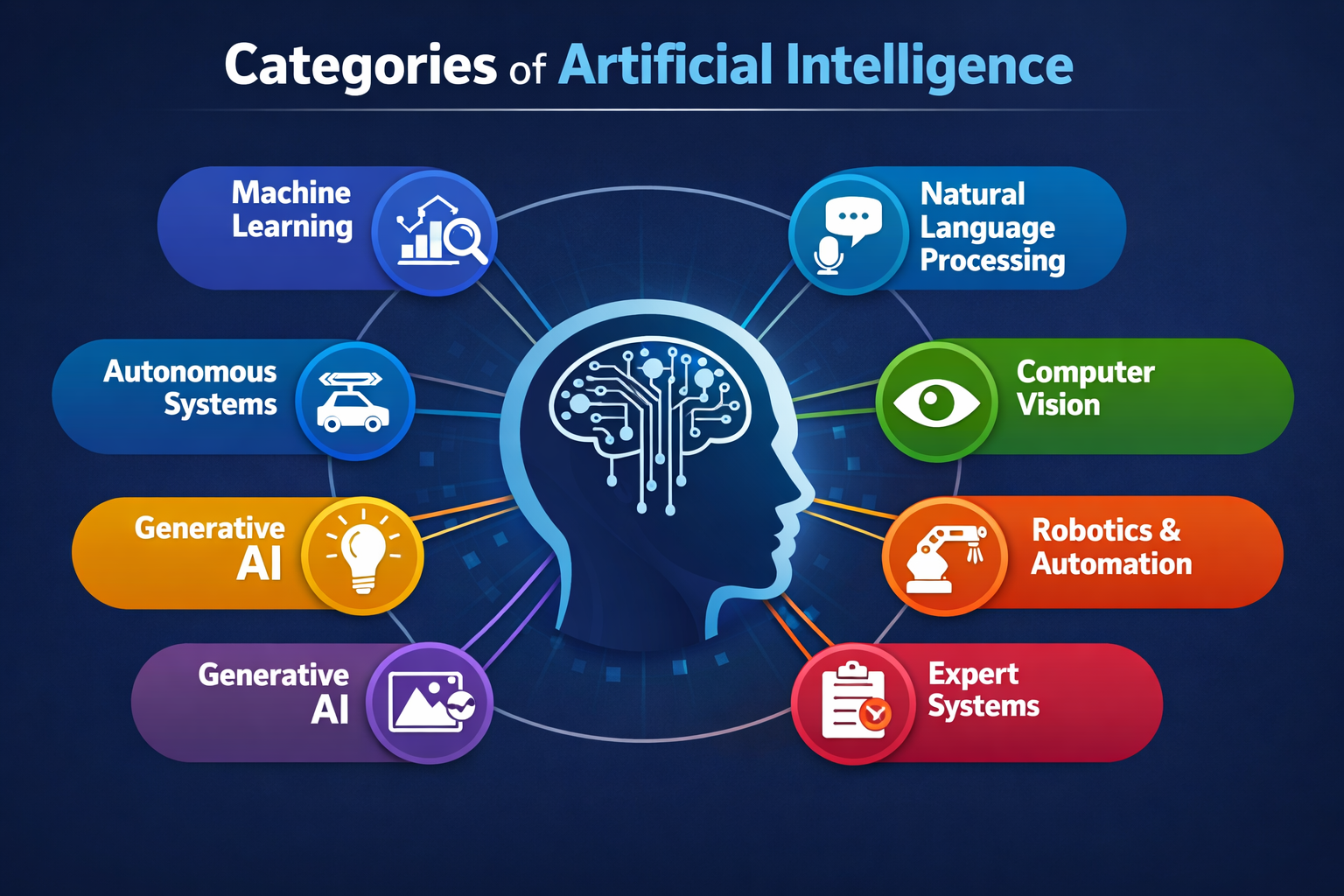
1. Machine Learning–Based AI
What Is Machine Learning AI?
Machine Learning (ML) is one of the most important categories of Artificial Intelligence. In this category, AI systems learn from data instead of being explicitly programmed for every task.
The more data these systems process, the better their performance becomes over time.
Examples of Machine Learning AI
- Email spam filters
- Product recommendation systems
- Fraud detection in banking
- Predictive analytics tools
- Image recognition software
Machine learning is widely used because it adapts and improves automatically.
Why This Category Matters
Machine Learning AI powers many modern technologies and is the foundation of most AI applications today. Without it, AI would be far less effective and scalable.
2. Natural Language Processing (NLP) AI
What Is NLP AI?
Natural Language Processing focuses on enabling machines to understand, interpret, and respond to human language. This includes both written and spoken language.
NLP allows humans to interact with computers in a more natural way.
Examples of NLP AI
- Chatbots and virtual assistants
- Voice recognition systems
- Language translation tools
- Text summarization software
- Sentiment analysis systems
Whenever AI reads, writes, or listens to language, NLP is involved.
Real-World Impact
NLP improves customer service, communication, accessibility, and content analysis. It is especially useful for businesses dealing with large amounts of text data.
3. Computer Vision AI
What Is Computer Vision?
Computer Vision is an AI category that enables machines to see, analyze, and understand images and videos.
It allows computers to extract meaningful information from visual inputs, similar to how humans use their eyes and brain.
Examples of Computer Vision AI
- Facial recognition systems
- Medical image analysis
- Object detection in self-driving cars
- Security surveillance systems
- Image classification tools
Importance of Computer Vision
This category plays a critical role in healthcare, security, manufacturing, and autonomous vehicles by enabling machines to make visual decisions.
Many people mix up AI categories with AI types, so understanding how artificial intelligence works at a basic level makes this distinction much clearer.
4. Robotics and AI Automation
What Is Robotics AI?
Robotics AI combines artificial intelligence with physical machines. These systems can perform tasks automatically, often in environments that are repetitive, dangerous, or difficult for humans.
Examples of Robotics AI
- Industrial robots in factories
- Warehouse automation systems
- Medical surgical robots
- Delivery robots
- Agricultural robots
Benefits of Robotics AI
- Increased efficiency
- Reduced human risk
- Faster production
- High precision
Robotics AI is transforming industries by automating complex physical tasks.
5. Expert Systems and Decision-Making AI
What Are Expert Systems?
Expert systems are AI programs designed to simulate human expertise in specific domains. They use predefined rules and knowledge bases to make decisions or provide recommendations.
Examples of Expert Systems
- Medical diagnosis systems
- Financial advisory tools
- Legal decision support software
- Technical troubleshooting systems
Where Expert Systems Are Used
These systems are especially valuable in fields where expert knowledge is rare, expensive, or time-consuming to access.
6. Predictive and Analytical AI
What Is Predictive AI?
Predictive AI focuses on analyzing historical data to forecast future outcomes. It helps organizations make informed decisions by identifying trends and patterns.
Examples of Predictive AI
- Sales forecasting
- Demand prediction
- Risk assessment tools
- Customer behavior analysis
- Stock market trend analysis
Business Value
Predictive AI helps businesses reduce uncertainty, optimize planning, and improve decision-making across industries.
7. Generative Artificial Intelligence
What Is Generative AI?
Generative AI creates new content instead of simply analyzing existing data. This content can include text, images, audio, video, or code.
Examples of Generative AI
- Text generation tools
- AI image generators
- Music composition software
- Video generation systems
- Code generation assistants
Why Generative AI Is Growing Fast
This category is popular because it boosts creativity, productivity, and content creation while reducing manual effort.
8. Autonomous Systems AI
What Are Autonomous AI Systems?
Autonomous AI systems can operate independently without constant human supervision. They observe their environment, make decisions, and take actions on their own.
Examples of Autonomous AI
- Self-driving cars
- Autonomous drones
- Smart traffic systems
- Automated trading systems
Challenges of Autonomous AI
- Safety concerns
- Ethical responsibility
- Regulation and control
- Reliability in complex environments
Despite challenges, this category represents the future of AI-driven independence.
Why Understanding AI Categories Is Important
Knowing AI categories helps you:
- Understand how AI is applied in real life
- Choose the right AI tools for business or learning
- Avoid confusion between AI buzzwords
- Make informed technology decisions
- Prepare for future AI developments
For beginners, categories make AI easier to understand and less intimidating.
The Future of AI Categories
As AI technology evolves, these categories will continue to expand and overlap. Many modern AI systems already combine multiple categories, such as machine learning, NLP, and computer vision.
The future will likely bring more advanced, ethical, and integrated AI systems that work seamlessly across industries.
Conclusion
Artificial Intelligence is not limited to one function or industry. It spans multiple categories, each designed to solve specific types of problems. From machine learning and computer vision to robotics and generative AI, every category plays a unique role in shaping the modern world.
By understanding AI categories, you gain a clearer picture of how AI works, where it is used, and how it will continue to transform our lives.

2 comments
Pingback: What Is Machine Learning in 2026? A Simple Beginner-Friendly Guide
Pingback: Best AI Tools for Students: 12 Powerful & Smart AI Tools